Fortune Robot
Digital Occultism Submission for Sónar+D 2026
Occultism derives its power from people believing beyond what they see and know. Digital occultism works the same way—the meaning we project onto technology often exceeds what the technology actually does.
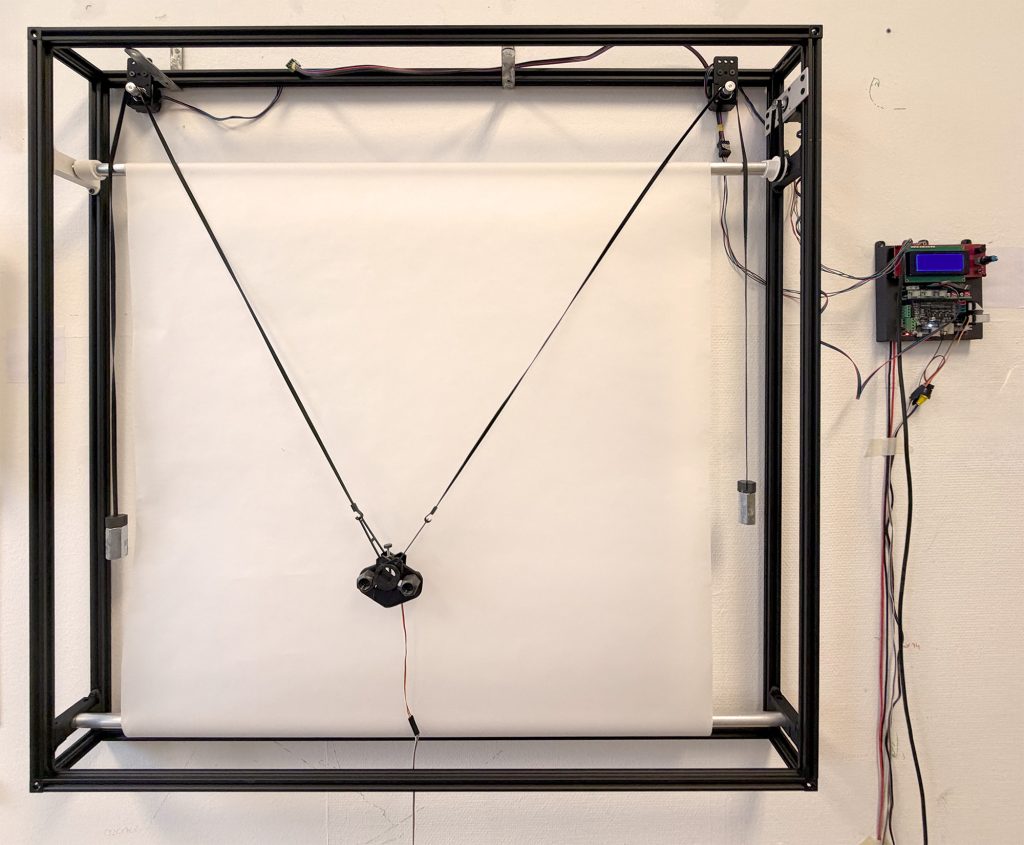
The Fortune Robot exploits this gap between technology and belief. It’s a wall-mounted drawing machine that reveals your fate if you press its button. Over 2-3 minutes, the dangling pen writes your fortune letter by letter in near-perfect handwriting. The stakes feel real even though you know it’s a trick.

HOW IT WORKS
Press the button and this wall-mounted drawing machine reveals your fate. The stakes are high: it will tell you your future. But unlike most tech, the Fortune Robot isn’t instant. Instead, suspense builds as the dangling pen writes each fortune letter by letter over 2-3 minutes in near-perfect handwriting.
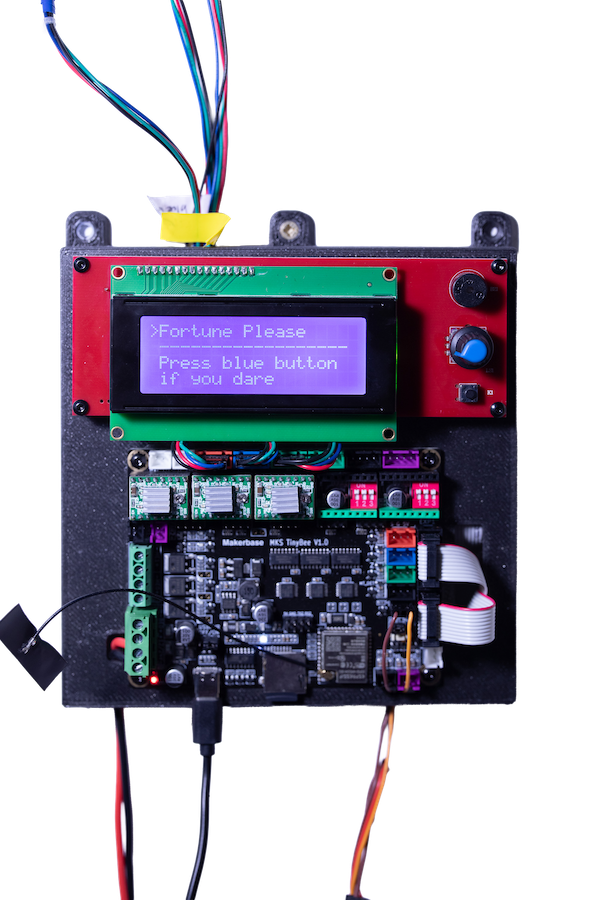
The technology is deceptively simple. It is a drawing robot made out of a repurposed 3D printer board, two motors, and a servo. Another motor advances the paper so each fortune is written one under another. The local computer power is comparable to a calculator, and yet it creates genuine awe in its audience.


THE FORTUNES
The fortunes are pre-generated using ChatGPT. I aim for them to be whimsical, absurd, literary, and occasionally meta. Each one functions as a beginning: the start of a story the audience co-creates, a prompt for new action, or a shift in how someone sees their world.
They’re designed to make people notice things differently, project meaning onto the mundane, or change their behavior in small ways.
While some fortunes are evergreen and possible at every exhibition, others are tailored to the specific site and event. For Sónar+D, this means fortunes that reflect Barcelona, the festival context, and/or specific projects and exhibits. It hopefully creates opportunities for participants to engage more deeply with where they are and what they’re experiencing.
The Magic
The Fortune Robot demonstrates the ELIZA effect: our tendency to project meaning onto machines. People know it’s a trick, yet they co-create meaning through their own projections, making the robot a catalyst for storytelling.
The robot harnesses the same psychological mechanisms as the human psychic—myth, story, suspense—proving that how we experience and interact technology matters as much as what the technology actually does. contemporary AI, slowing people down to consider what they’re willing to believe.
History and Versions
The Fortune Robot began simply as two motors mounted on a wall. In this first iteration, it was exhibited in Vienna, Austria at Creative Cluster Open Studios and Galerie Graf. It was then invited to be exhibited during the TedAI conference.
In an upgraded form, with a wooden frame and self-advancing paper, it was then exhibited at Das Lot Artificial Territories.
For Sónar+D, I propose the Fortune Robot in another upgraded form. I have just built the newest prototype which is a frame with self-advancing paper built out of black v-slot, making it sturdier and more sleek. Dimensions of frame: 114x114x12cm
Over its lifetime, the Fortune Robot has provided almost one thousand fortunes.
About Me
I stumbled into technological art almost by accident. While drawing by hand—gestural, messy work—I discovered drawing machines and was immediately struck by how opposite they were from me. I wondered: how could I make something surprising with such a predictable, precise machine?
My practice became an exploration of that question, introducing human interference into robotic lines, building my own machines, and eventually inviting others to collaborate (after all, more humans meant more surprise).
To learn more about my work, check out my artist statement, download my CV, or check out my Instagram @i.draw.monkeys.